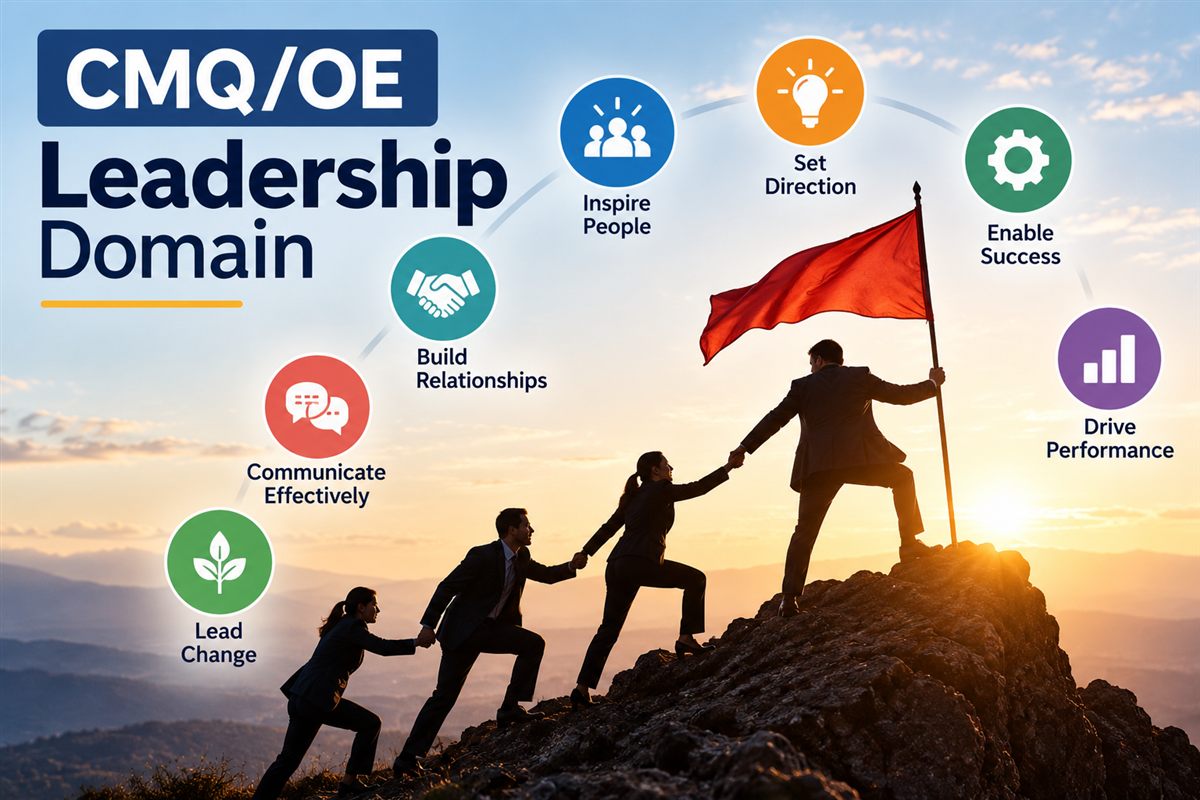
At 20% of the CMQ/OE exam, Leadership is the single largest Body of Knowledge domain — larger than any individual quality tool or methodology section. That surprises a lot of candidates who come from technical quality backgrounds and expect the exam to be mostly about control charts and process tools. ASQ's reasoning: a Manager of Quality/Organizational Excellence is expected to lead change and shape culture, not just apply tools — so this domain tests judgment and organizational thinking, not technical calculation.
Why Leadership Carries the Most Weight
At 20% of the CMQ/OE exam, Leadership is the single largest Body of Knowledge domain — larger than any individual quality tool or methodology section. That surprises a lot of candidates who come from technical quality backgrounds and expect the exam to be mostly about control charts and process tools. ASQ's reasoning: a Manager of Quality/Organizational Excellence is expected to lead change and shape culture, not just apply tools — so this domain tests judgment and organizational thinking, not technical calculation.
What "Leadership" Actually Covers on This Exam
- Organizational leadership styles — situational leadership, transformational vs. transactional approaches, and when each fits a quality initiative.
- Communication and influence — how a quality leader builds buy-in across departments that don't report to them directly, a common CMQ/OE scenario.
- Building a quality culture — moving an organization from "quality is the quality department's job" to shared ownership across functions.
- Classic quality philosophies — Deming's 14 Points, Juran's Trilogy, and Crosby's Zero Defects — not just as history, but as frameworks you're expected to apply to a described scenario.
- Ethics and professional conduct — recognizing conflicts of interest, data integrity issues, and ASQ's code of ethics in applied situations.
A quality leader's hardest job usually isn't finding the defect — it's getting a skeptical department to actually change how they work. ASQ's leadership questions are built around that exact tension.
Deming, Juran, and Crosby — The Distinctions That Matter
Questions rarely ask you to recite these philosophies — they describe a scenario and ask which philosophy or principle it reflects:
- Deming emphasized systems thinking and reducing variation — look for scenarios about statistical understanding of processes and management's responsibility for most quality problems ("85/15 rule": most defects are system-caused, not worker-caused).
- Juran framed quality management as a trilogy: planning, control, and improvement — look for scenarios structured around these three phases.
- Crosby is associated with "quality is free" and zero defects as a mindset/standard, not a statistical target — look for scenarios about prevention-focused culture rather than acceptable defect rates.
Change Management: The Practical Core of This Domain
A large share of Leadership-domain questions are really change-management scenarios: a new quality initiative is being resisted, a cross-functional team isn't aligned, or leadership support is inconsistent. ASQ expects you to recognize:
- Resistance to change is normal and should be anticipated, not treated as a one-off problem
- Communication must be tailored to each stakeholder group's actual concerns, not a single generic message
- Sustained change requires visible leadership commitment — a quality initiative with no senior sponsor tends to fail, and the exam rewards recognizing this